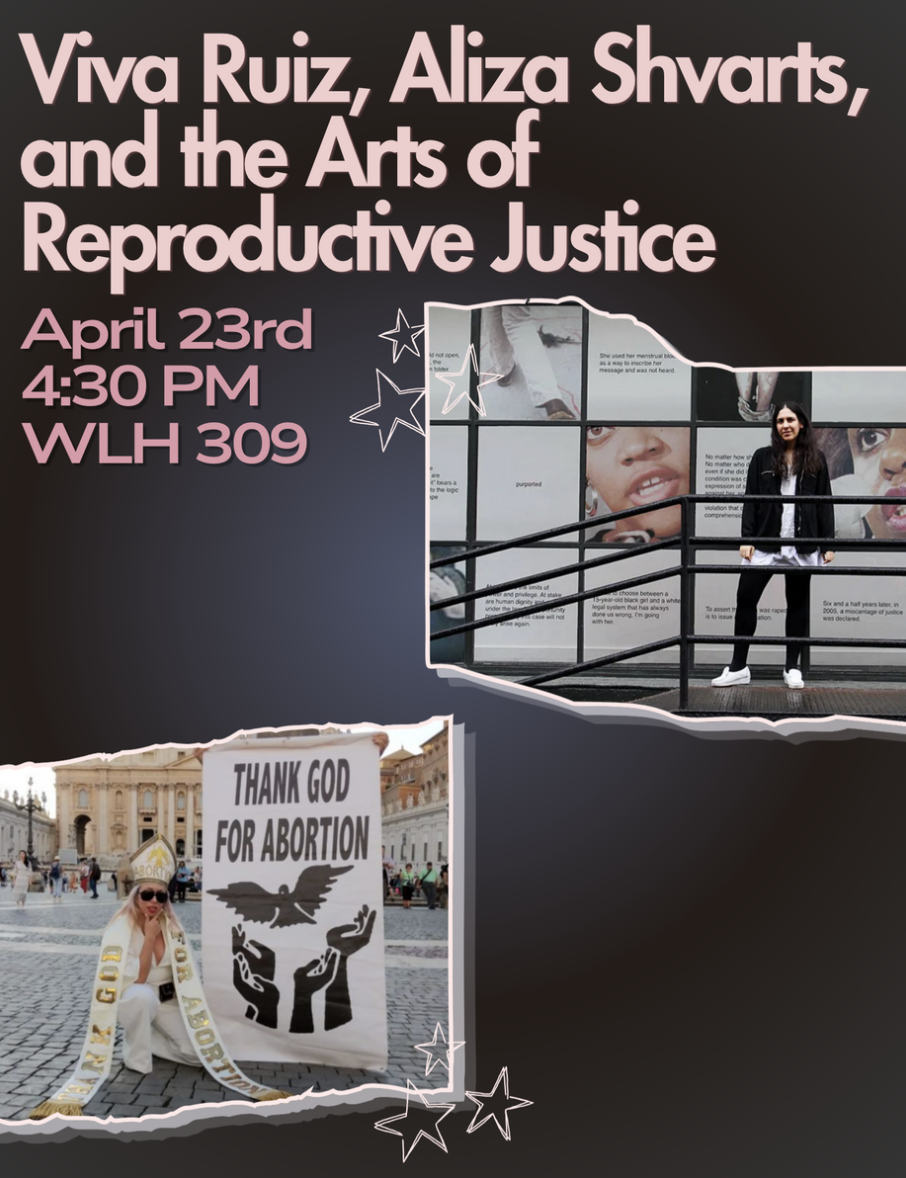
Thursday, April 23, 2026
4:30pm EDT
WLH Room 309, 100 Wall St
New Haven, CT 06511
Artists Aliza Shvarts (NYU Performance Studies MA '10, PhD '20) and Viva Ruiz will join William Robertson Coe Professor of Women’s, Gender, and Sexuality Studies, and Professor of American Studies Roderick Ferguson in a conversation about the role of art in reproductive justice. Ruiz and Shvarts are both artists who have made work about abortion—a form of brutally criminalized healthcare and a social justice issue underrepresented in the art world.
Shvarts is a visual artist and writer who explores how the body means and matters and how the subject consents and dissents. These are themes that extend from work she made while an undergraduate at Yale, Untitled [Senior Thesis] (2008), which consisted of “self-induced miscarriages,” and was censored by the university as it became the subject of international controversy.
Viva Ruiz is a community educated artist and advocate, and a descendant of factory-working Ecuadorian migrants raised in Jamaica, Queens. They are a maker working in performance, film, writing, music, and dance with a collaborative practice grown out of their experience in NYC nightlife. Ruiz’ ongoing project Thank God for Abortion (2015–present) is simultaneously an artwork and collective invitation that agitates and affirms through direct action, performance, and multimedia incarnations.
Having found each other through the gravitational force and aligned frequencies of their respective work, the artists will discuss the role of language, image, and movement in the fight for reproductive justice. What is the role of creativity in envisioning and enacting the liberatory principles of reproductive justice? And how can reproductive justice–a framework originated by Black women–link all struggles for liberation?
The artists would like to express their joy to be in conversation with Professor Rod Ferguson. Professor Ferguson’s activation for this talk at Yale is at once a return to an originary scene, an invitation for deeper inquiry, and a vindication for all kinds of thinkers and makers engaged in this collective work despite institutional silencing and censorship.