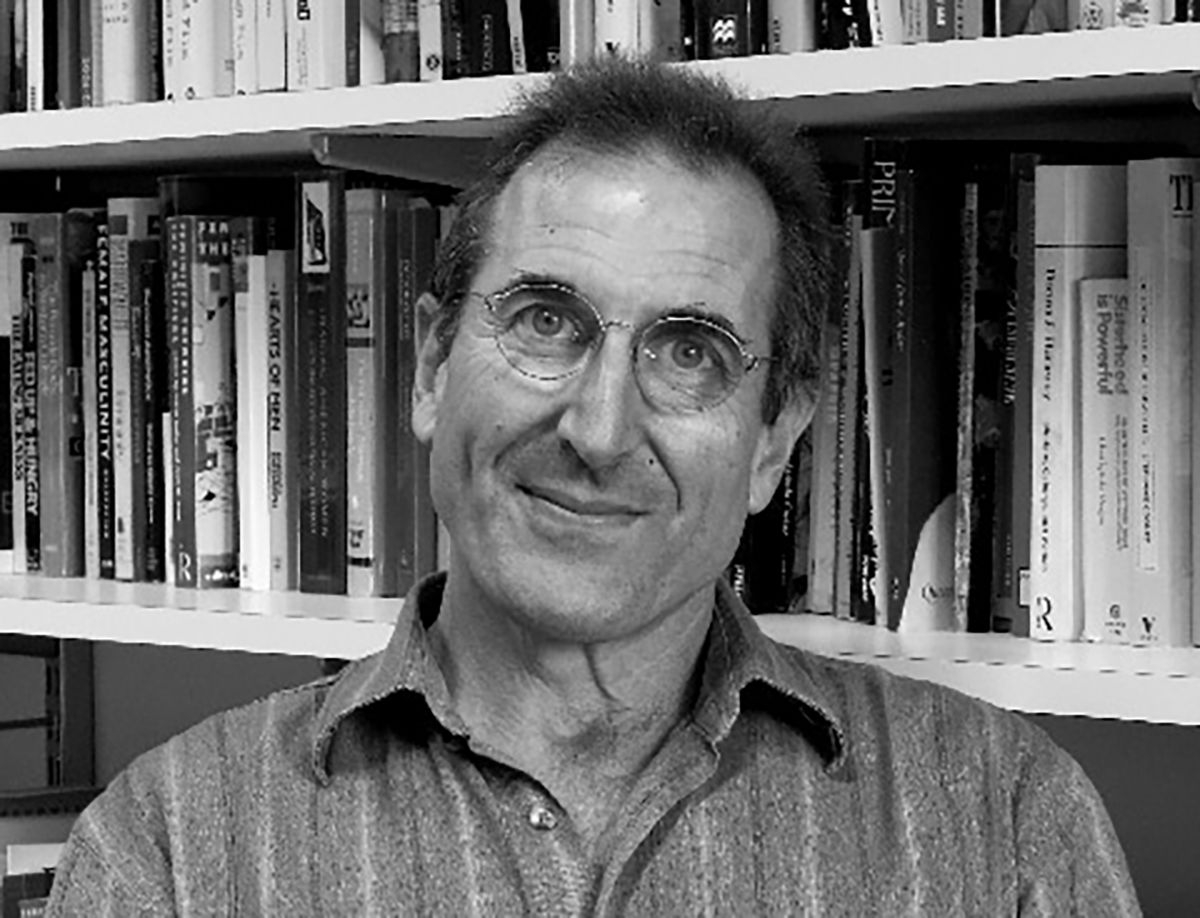
Randy Martin was a generous mentor and brilliant thinker. He challenged me to think critically and create art fearlessly. I will be forever thankful for his warmth and encouragement.
- Dr. Liz Andrews (class of 2009)
Creating spaces where one can think about ways of thinking, turning thought, and futures, into present practice, is a truly radical thing. It's a long-held tradition that this is the root and route to liberatory practice, and it was an honor to cultivate these modes of living otherwise. Thank you, Randy Martin.
- Dr. Victor Peterson (class of 2014)
Randy Martin (1957-2015) was an intellectual luminary who in his work as a scholar, teacher, artist, and activist explored the intersections between art, culture, society, and politics. He was Professor and the first Chair of the Department of Art & Public Policy, and helped to found the MA in Arts Politics program. He oversaw the curriculum development of Tisch School of the Arts’ core writing curriculum for first-year undergraduates, in collaboration with NYU’s Expository Writing Program. He also served as Associate Dean of Faculty and Interdisciplinary Programs at Tisch.
Martin held degrees in Sociology from the University of California, Berkeley (B.A. 1979), the University of Wisconsin, Madison (M.A. 1980), and the City University of New York (Ph.D., 1984). Prior to his arrival to NYU in 2000, Martin was a Professor of Sociology and Chair in the Department of Social Science at Pratt Institute. He was also a resident Fellow at the Humanities Research Institute, U.C., Irvine in 1993.
Martin’s extraordinary scholarly work was interdisciplinary, embracing the fields of cultural studies, labor studies, sociology, geography, and performance and dance studies. He was visionary in his pedagogy and capacity to build academic programs that could significantly contribute to cultivating new generations of scholars, artists and activists. He also knew that theory, imaginative thinking and making, as well as strategic organizing and community building must work together for new paradigms to emerge.
He was a renowned scholar whose vital contribution to cultural studies resonates through his many texts. His legacy lives on in his numerous publications, including the books: Knowledge LTD: Toward a Social Logic of the Derivative, Temple University Press, 2015; Under New Management: Universities, Administrative Labor, and the Professional Turn, Temple University Press, 2011; An Empire of Indifference: American War and the Financial Logic of Risk Management, Duke University Press, 2007, in the Social Text Book Series; Financialization of Daily Life, Temple University Press, 2002; On Your Marx: Relinking Socialism and the Left, University of Minnesota Press, 2001; Chalk Lines: The Politics of Work in the Managed University, (Ed., Duke University Press, 1999); Critical Moves: Dance Studies in Theory and Politics, Duke University Press, 1998; Socialist Ensembles: Theater and State in Cuba and Nicaragua, New edition. Vol. 8. University of Minnesota Press, 1994; Performance as Political Act: The Embodied Self, Bloomsbury Academic, 1990.
His work on a number of diverse editorial projects, included: The Returns of Alwin Nikolais: Bodies, Boundaries, and the Dance Canon (with Claudia Gitelman), Wesleyan University Press, 2007; Artistic Citizenship: A Public Voice for the Arts (with Mary Schmidt Campbell, TSOA Dean and a co-founder of the Dept. of Art & Public Policy), Routledge, 2006; SportCult (with Toby Miller), University of Minnesota Press, 1999; and New Studies in the Politics and Culture of U.S. Communism (with Michael Brown, Frank Rosengarten & George Snedeker), Monthly Review Press, 1993. Martin was also active in the Social Text collective beginning in 1983, and served as co-editor from 2000-2006.
Martin’s dance journey began in the late 1970s at the University of California, Berkeley. He was as curious about why we move as how we move. That curiosity deepened during his graduate studies at the University of Wisconsin, where a pivotal encounter with choreographer Claudia Gitelman encouraged him to move to New York City. There, he continued his training with Alvin Nikolais and Murray Louis, immersing himself in a world where experimentation and inquiry met in equal measure. In the vibrant downtown dance scene of the 1980s, Martin performed with artists including Claudia Gitelman, Martha Bowers, Pooh Kaye, and Nina Martin. He was both an observer and participant, testing how movement could express not only emotion but also the social, economic, and political currents shaping people’s lives. His practice as a dancer and choreographer was inseparable from his work as a thinker and writer.
Martin became one of the most prominent dance scholars of his generation. His groundbreaking book Critical Moves: Dance Studies in Theory and Politics (1998) wove together his experiences as a performer and theorist to ask how dance might serve as a form of resistance and social critique. In later years, he introduced the concept of the “social kinesthetic,” suggesting that society’s values are literally embodied in the way it moves. He saw, for instance, in ballet’s reach for height and grace a reflection of the human longing for transcendence and connection to the divine. He believed that to understand movement was to understand something essential about being human—about how we organize, struggle, and dream together. His ideas continue to resonate, inspiring dancers, thinkers, and cultural leaders to see motion itself as a way of knowing, questioning, and imagining new futures.
Randy Martin moved through the world with a dancer’s awareness and a scholar’s insight. His compassion, lively wit, attentiveness, and dialogical spirit were felt in his interactions with students and colleagues and touched everyone who interacted with him. His untimely passing away left a void in multiple fields, and among all those who knew, respected and loved him. In his memory, our department is honored to celebrate the life and contributions of our chair, colleague, teacher, mentor, and friend, Randy Martin.
If you would like to donate to the Randy Martin Memorial Schalorship Fund to support the APP students, please click here.