A Review of Crystal Pite’s Polaris
By Mimi Liu
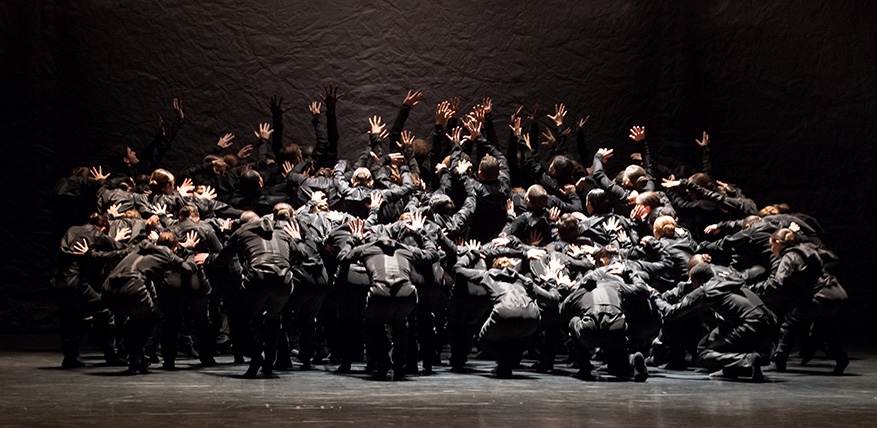
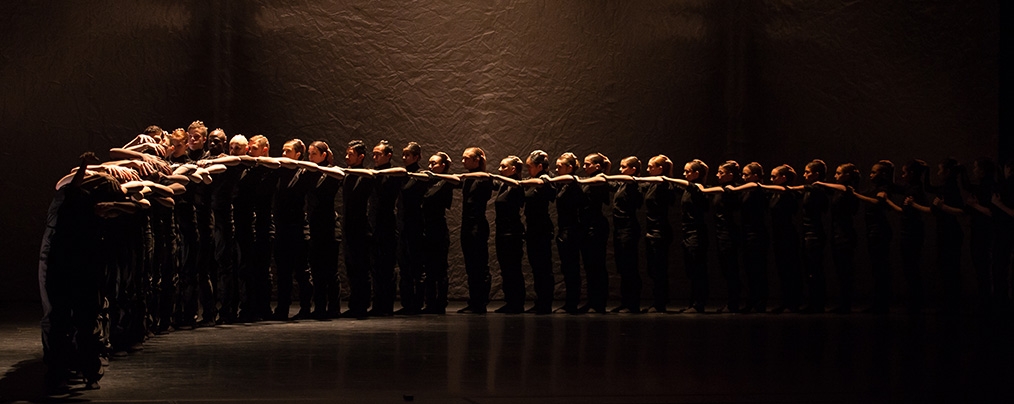
Crystal Pite’s Polaris was a magnificent visual stimulation. This ambitious piece (ambitious, in that the cast included sixty-six dancers) triggered many vivid images of nature for me. One was the wave of a dark sea, or the tides ebbing freely across the stage in different speeds. As I watched the piece intensely, I also imagined a mysterious black hole that drew me more and more towards the stage. It was a super powerful suction or a magnet that sucked the audience into the group of dancers, and I remember at one fleeting moment on the edge of my seat, I wanted to resist its group power. On a lighter interpretation, I thought of a school of piranhas, or a clan of ants, working fiercely towards a common goal. Perhaps also a large set of dominos that fell from one form into the next. No matter how one can describe the images that came to mind, the dominating power of a group seemed to be the central concept of this piece. In the midst of all the camaraderie to achieve a common goal, individual identities were being stripped away in order to become a stronger whole.
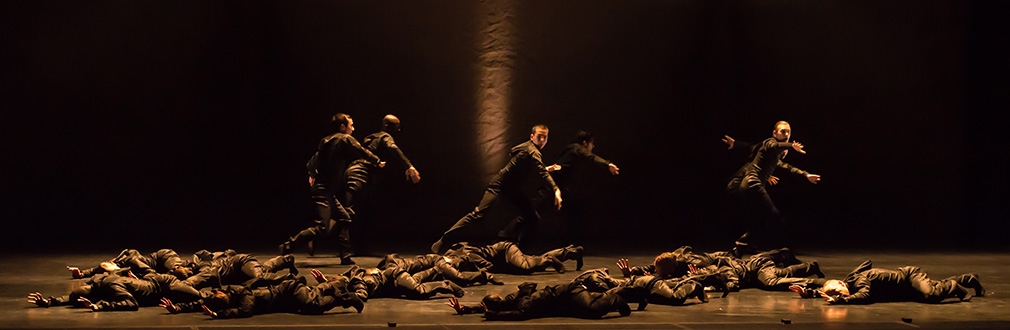
Different sections ranged from a full cast dancing in unison to a couple sections of pas de six or pas de deux, but the former has been choreographically prevalent. Because of the contrast between smaller and bigger group sizes, I was able to infer that the individuals in this dance tried to break free from the collective body. I wanted to breathe more, because the piece was very motional, almost as if my diaphragm were expanding and shrinking constantly with what I was seeing on stage. The dramatic music also assisted the dance with getting more fresh air to ripple through my body. My overall response was that this piece was refreshing and breathtaking!
Polaris had a number of choreographic contrasts. The first one was chaos versus order (unison). The second was adding versus subtracting the bodies in space, making it more confined or spacious. The third was I think the most emphasized, which was the group (the power of the many) versus the individual. The dark pulsing communal energy dominated the dance, more so than the few soloists. And the fourth one (resulting from the third contrast of group vs. individual) was being buried into the group versus standing out from the rest of the group. When I say buried, I mean when the stage is fully invaded by all sixty-plus bodies, and when I say standing out, I mean when some individuals broke away from the large ensemble and danced with less claustrophobic spacing. When the soloists were dancing on stage, I was able to pay more attention to what they were actually doing. However, when the entire cast of millions appeared on stage, it became visually overwhelming, and I lost my focus on them as individuals.
Paradoxically enough, I knew most of the dancers on stage because they were the Tisch students. I knew their names, I saw them everyday, and I knew their faces. When all of them danced together plus the dancers of Kidd Pivot, I couldn’t bother to notice who was who. Instead, I cared more about how they looked as a group. What they were trying to say by metamorphosing into various shapes and sculptures became my point of interest whenever the group danced together as one.
Circular movements versus angular/dynamic movements was another contrast within this sixteen-minute piece. The piece started with a circular clump, almost like a group of penguins staying close with one another in order to preserve their body heat to brace for the freezing winter. Thus, this opening part created a harmonious feel visually. In contrast, an example of an angular/dynamic movement took place during the middle of the dance when the stage was filled with all the dancers, and they all kneeled on the floor, supported by their head with all elbows pointing upward. This moment of unison stillness was soon interrupted by what seemed like a random pattern of dynamic pulses. It was aesthetically a bit eerie in that all the dancers looked almost like black tarantulas with their legs spread across the stage…the complete opposite of harmony!
Pite’s choreographic strategies included using canon, stillness, unison, expanding and shrinking the space using impulsive movements every now and then, making shapes and forms organically and then unfolding or reforming them, making it all becoming something else. These choreographic tools served to create powerful cause and effects that helped to establish the concept of group power. In the parts that had all the dancers, if one of them moved, then they all moved. There was always an instigator, one who dropped one pebble into the water and there would be an aftereffect happening throughout the entire stage.
One final note about Polaris: although technically the Tisch dancers were differentiated from Pite’s own dancers, I felt that the Tisch dancers were just as good, if not more energetic, as the six company dancers from Kidd Pivot. Bravo Tisch Dance!