Cinema Studies Student Conference
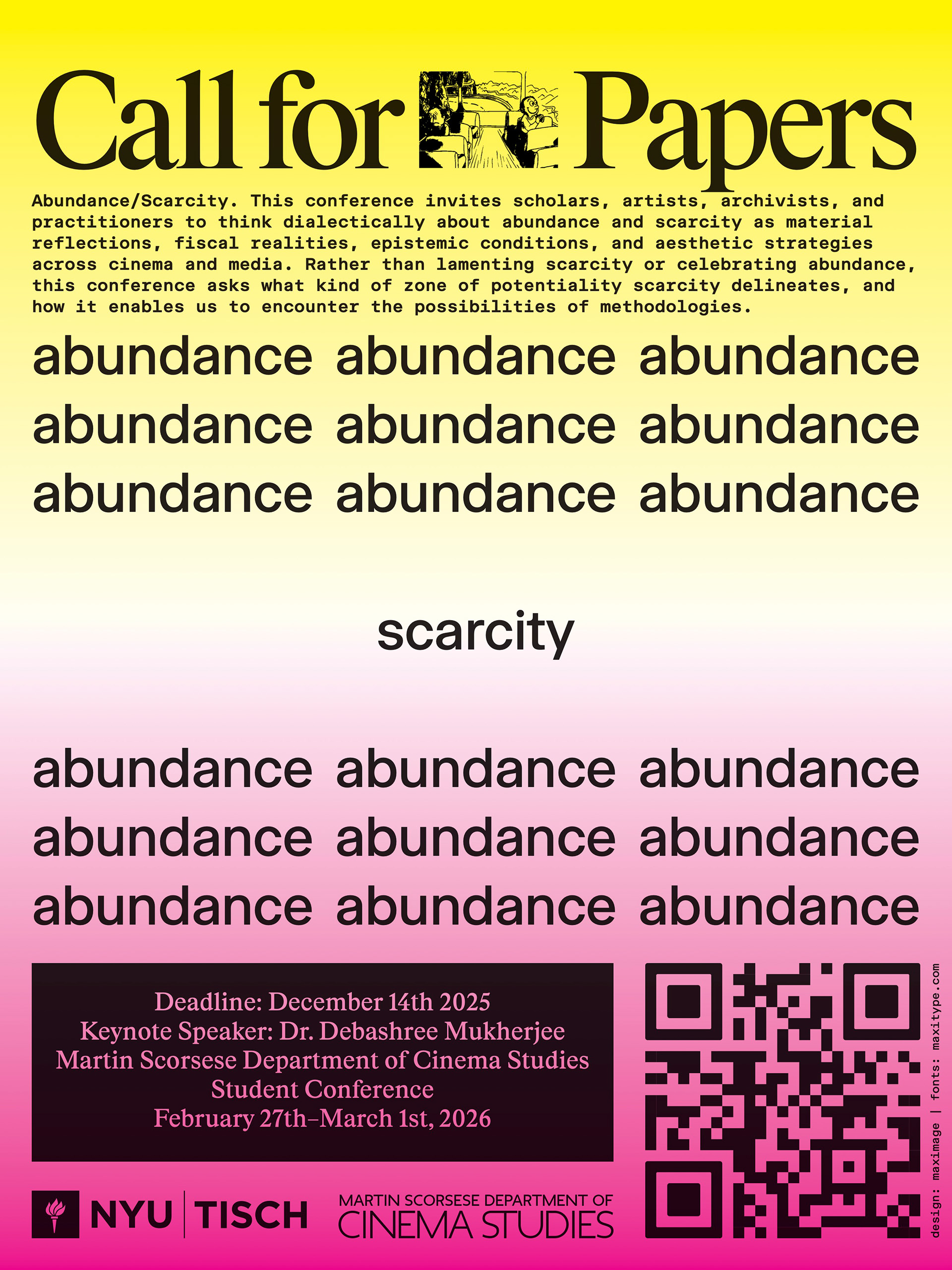
Abundance / Scarcity
Friday, February 27 - Sunday, March 1
Michelson Theater, 721 Broadway, 6th Floor
Join us for a weekend of conversation with the annual Cinema Studies Student Conference. Schedule to be announced.
Keynote Speaker: Debashree Mukherjee, Columbia University
This is an in-person event, open to the public. Prior registration is required. Non-NYU attendees will receive emailed instructions for building access and may be asked to present a government-issued photo ID upon arrival. NYU attendees must present their NYU ID.
February 27th - FRIDAY OPENING DAY
2:00 pm - 5:30 pm
6 pm - Special Film Screening
2:00 pm Opening Speech by Dr. Dana Polan (Chair)
1.1 Affect and Sensorial Regimes
Respondent: Dr. Dana Polan
Participants
AJ Castle – “Just Keep Making Videos”: Forms of Numbness in We’re All Going to The World’s Fair
Xiaoyu Song – Autistic Spectatorship, Queer Violence, and Poetic Nonfiction in Ode to Orchid
Sayaka Miyauchi - Fat Ghost Theory: Weightless Fatness in Ghostbusters (1984) and Casper (1995)
1.2 (4:00 pm) Methodologies that refuse to speak for
Respondent: Dr. Toby Lee
Participants:
Hamin Jeong – Against Representation: Ethics of Unknowability in Making a Map about Invisible Mountain by Jinah Jeong
Shinyoung Kim – Regarding the Pain of Ours: Scarcity, Expressive Devices, and Shared Suffering in Ethnographic Film
Kaycee Hailey – EXXXcessive Beauty: The Paradox of Respectable Pinups in Jet, Ebony, and Duke
6 pm - SECRET ANALOG FILM SCREENING
—--------------------------------------------------------------------------
February 28th - SATURDAY
9:30 am - 6 pm
7 pm - Keynote Speaker
2.1. (9:30 am) Form I: Time & the Aesthetics of Insufficiency
Respondent: Dr. Laura Harris
Participants
Victor Omojola – Photographic Apokatastasis and the Insufficient Image
Justine Cheng – The Abundance of the Instant
Bernardita Cubillos –Excess of Power and Cinematic Space: Extensive and Intensive Monstrosity in Frankenstein and Nosferatu
2.2. (11:00 am) Counter-Archives and the Limits of Intimacy (Hybrid)
Respondent: Dr. Zhen Zhang
Participants
Adhila Abdul Hameed (Zoom presentation) – Counter-Archival Abundance: Kamal Aljafari, Speculative Historiography, and the Mnemonics of Scarcity (Cancelled)
Rong-Han Shiao – Non-Translation and Collage as Taiwan Theory: Rethinking Taiwanese Marginal Cinema through The Thrilling Sword (1981)
Kelsey Moore – “Don’t Fence Me In”: The Aesthetics of Waiting in the Camp Family Photo Album
Ludovica Amaro – Looking for the Voids: Italian Internal Colonialism and Demartinian documentaries
2.3. (2:00 pm) Queer and Gendered Visual Cultures
Respondent: Dr. Robert Stam
Participants
Zhiyu Benjamin Li – Queer (In)Visibility and Movement in early 21st-Century Iranian Cinema
Ariana Martinez – Archiving the Apocalypse: Remembering Love at the End of the World
Ribamar Jose De Oliveira Junior - Fetish and BDSM in Brazilian Queer Cinema
2.4. (3:30 pm) Institutional Archives, Bureaucracy & Governance
Respondent: Dr. Dan Streible
Participants
Leah Simon – Audits, Reviews Boards, and Their Discontents: Content Moderation in U.S. Post-War Religious Education Film Distribution
Daniela Nigri –Fragmented Landscapes: Montage and Reimaginings across Transnational Archives
Janay Joseph - The Sugar Situation: Tracing Communications Networks during Labor Movements on Sugar Plantations in South Florida
Zohra Benzerga – Shifting Sands: Unsettled Epistemologies and Atomic Catastrophe in the Sahara Desert
Yashmita – Monumental India / Everyday India: A Two-Channel Interruption — Varanasi
KEYNOTE SPEAKER 7 PM: DR. DEBASHREE MUKHERJEE (COLUMBIA UNIVERSITY)
“Plantation Cinema: Abundance/Scarcity Across Environment and Archive”
March 1st - SUNDAY
9:30am-12:30pm
3.1. (9:30 am) Form II: Time & the Aesthetics of Insufficiency
Respondent: Dr. Shawn VanCour
Participants
Jiaze Li – Between the Acres
Elstir Bazzoli – Resistance to Revelation, Revisited: Enigmatic Apparitions and Aestheticized Forgetting in Krasznahorkaian Cinema
Cecilia Kryzda –Editing the Crisis: Film, Genetics, and Making Decisions
3.2. (11:00 am) Infrastructure, Platforms, and the Political Economy of Media
Respondent: Dr. Anna McCarthy
Participants
Hazem Fahmy – "It Was Like a Crusade:" Epic Cinema & the Politics of the "Off-Shore" Production
Zhiyuan Tan - Curating Under Precarity: Independent Film Festival Survival in Contemporary China
Ankush Bhuyan – Cinema Made Otherwise: Videocinema and Film Production in Assam, Northeast India
12:45 pm After-Party Near Campus (TBA)