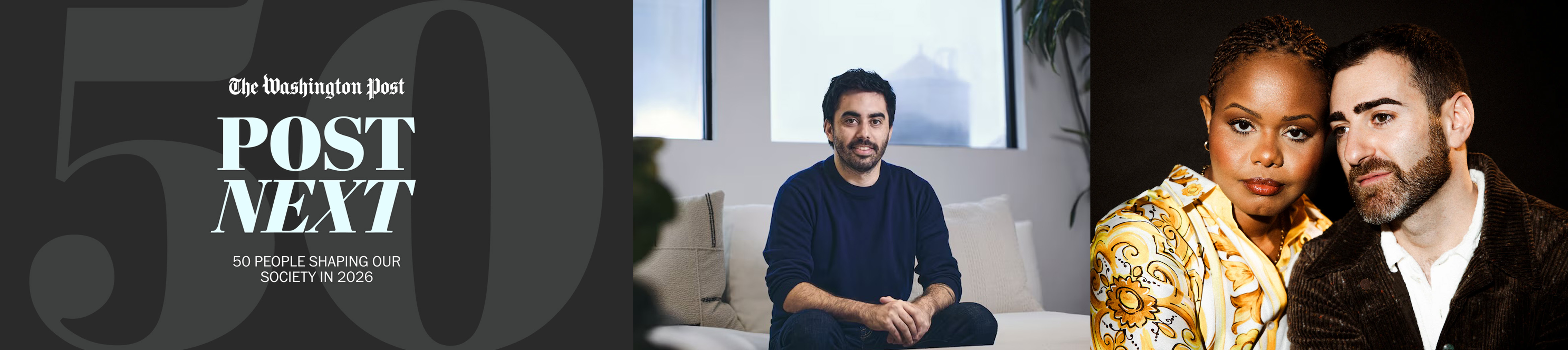
The Washington Post announced their second annual Post Next 50, a collection of the 50 most influential individuals working toward building a bold future today. As written in the article, "together, they represent where power is headed and how it’s shaping our society."
This year, three NYU Tisch alumni are featured in this list. Below, find more information, and see the full list here.
.
Artificial intelligence has created a firestorm in Hollywood, and Cristóbal Valenzuela is at the center of it.
Depending on whom you ask, the AI video-generation company he leads, Runway AI, is either a dangerous force undermining the filmmaking profession, or the provider of tools that will unlock a new era of creativity and allow anyone with a computer to make feature-length films.
But Valenzuela’s goals are even more ambitious. He sees AI as ushering in a completely new art form, one that we are only beginning to imagine. “Filmmaking and photography wasn’t a better version of doing oil and painting. It was a totally different medium of understanding the world,” he said. “AI is on a similar level. It’s a new medium that requires a new sort of artist.”
Valenzuela grew up in Santiago, Chile, where he started making home videos with his friends as a teenager. He paid his way through college building websites and shooting promo videos for businesses, devouring films he borrowed from the library in his free time. After graduation, he taught design at a university in Chile and started researching how AI algorithms could be used in art. In 2016, he moved to the United States to study at New York University’s Tisch School of the Arts. He founded Runway with two classmates in 2018.
Runway was building AI video and image tools well before OpenAI launched ChatGPT and kicked off the AI boom in 2022. But the company has benefited from the massive wave of interest and funding in the technology. It has raised more than $540 million, inked deals with most of the major film studios and runs its own AI-focused film festival.
Now, Valenzuela is pushing the company to go beyond the film industry. The AI world is obsessing over “world models” — AI systems that can simulate sections of reality like an extremely detailed video game might. Beyond opening up new possibilities for entertainment, world models could lead to breakthroughs in robotics and make it possible to create training simulations that feel real for high-stakes professions like medicine or firefighting.
Runway isn’t alone. The industry’s biggest players, including Google and OpenAI, are working on world models of their own. “AI is basically eating Hollywood, and it will continue to eat video and entertainment really fast,” Valenzuela said. “But video models are more than just technologies to make stories. They’re becoming the next frontier of intelligence.”
The premise of the Broadway-bound musical “Wanted” would be too outrageous to believe if it weren’t inspired by family lore: mixed-race twin sisters passing for White and blazing a vigilante trail through 1893 Texas.
Growing up, Angelica Chéri recalls, every relative seemed to spin a different tale about the ivory-complexioned pair in her grandmother’s photo album. When she and composer Ross Baum, both drama geeks at heart, approached their final MFA project at NYU Tisch School of the Arts, the Chéri family legend struck them as perfect for a musical. “The details are of our making, but the context is not,” Chéri says of their depiction of racial injustice, which clearly resonates today.
About 12 years later, the duo has written more than 100 songs for potential use in the show, and it’s soon headed to Broadway. (A 2024 recent production, at New Jersey’s Papermill Playhouse, won critical acclaim, including from myself.)
Chéri is based in Los Angeles, where she also writes for TV and film and is developing another Broadway-aimed show, about Maya Angelou; Baum lives in New York, where he runs a music studio. “We come from such different backgrounds, but we are so in sync,” Chéri says on a three-way Zoom call, during which the duo frequently finish each other’s sentences. “When we are in the rehearsal room together, we are both truly aligned with our life’s purpose,” Baum adds.
Chéri reflects on what it means to share her ancestors’ untold history: “I am thinking about the young people who say, ‘No one who looks like me has ever told my story before, and maybe now I can.’”
The creative partnership seems likely to last. “We have a lot more stories to tell,” Baum says before Chéri cuts in: “Get ready, Beyoncé. We’re going to call you, boo.”