It’s been more than three decades since the Americans with Disabilities Act (ADA) was passed into law, an indispensable civil rights triumph that afforded people with disabilities further protection against discrimination and introduced reasonable accommodations. In recent years, continued progress has turned up in small but detectable ways: the expanded use of closed captions and sign language interpreters, strengthened education and awareness programs, and growing employment numbers among people with disabilities.
But headway has sometimes waned. The battle to close or remediate state-run institutions is an ongoing one, and there remains a sense that disability rights have not penetrated the public consciousness with the same force as other social issues.
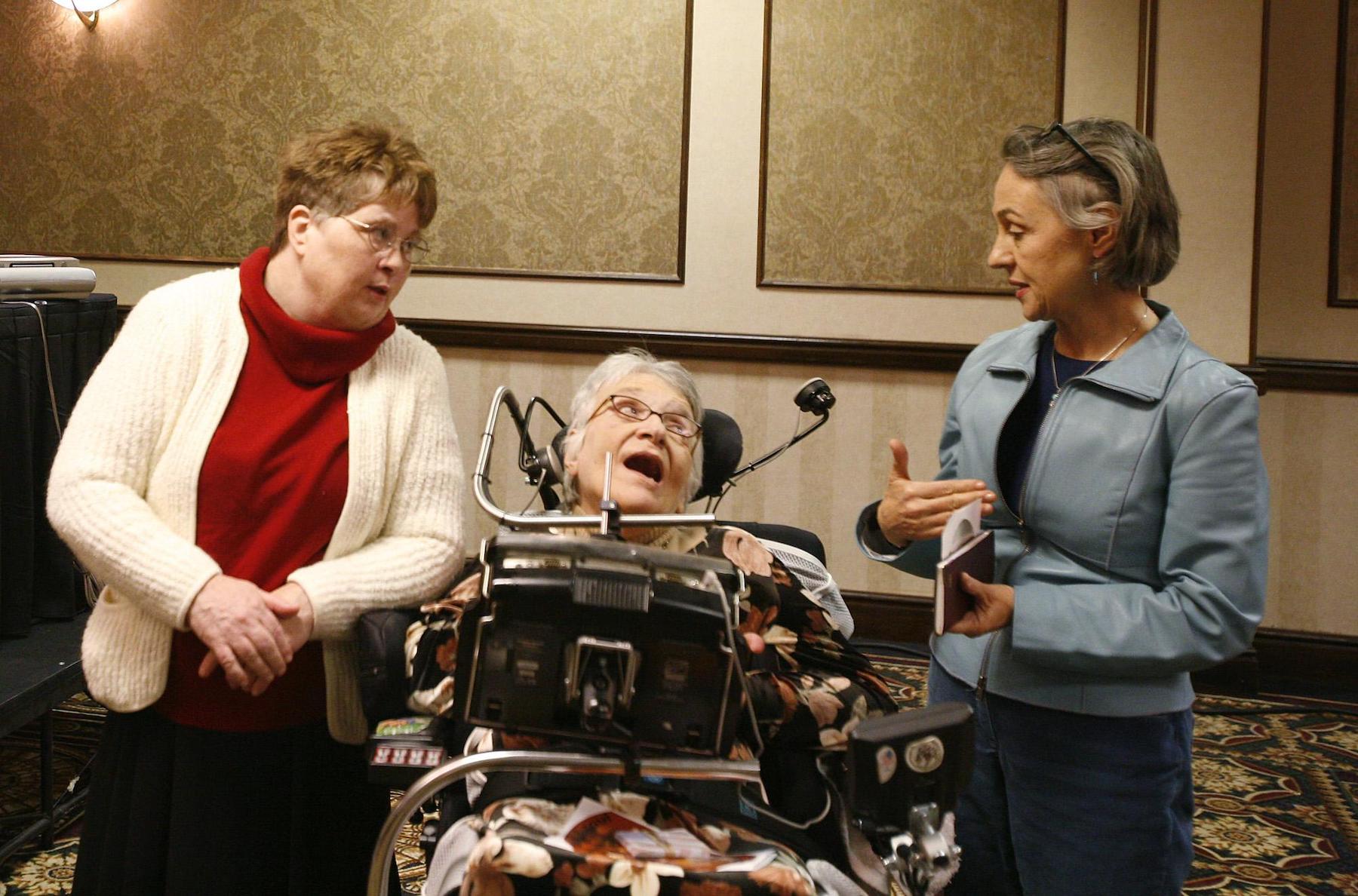
Filmmaker and Distinguished Teacher Alice Elliott’s (Kanbar Institute, Undergraduate Film & Television) documentary work has often challenged the public’s perception of ability and shed light on the fight for independent rights in the disabled community. Her debut film, The Collector of Bedford Street, followed her neighbor Larry Selman, a community activist and fundraiser who had an intellectual disability. Elliott’s 2008 follow-up, the PBS award-winning Body & Soul: Diana & Kathy, tracked the titular duo’s journey from their home in Springfield, Ill, to Washington, D.C, to advocate for independent lives. To this day Diana Braun, a subject of Elliott’s film who has Down syndrome, is among the country’s most remarkable advocates with disabilities.
October is recognized as National Disability Employment Awareness Month, which “celebrates the contributions of America’s workers with disabilities past and present and showcases supportive, inclusive employment policies and practices.” In honor of this moment, we’ve reconnected with Alice Elliott—and also heard from disabled rights activist Diana Braun—to assess the state of disability rights in America and how the movement can be infused with new vigor.
Alice, how did your relationships with Diana and Kathy inform your advocacy work in the disabled community?
Alice Elliott: I had previously spent time with Larry Selman, who was the subject of one of the first films I made, The Collector of Bedford Street. Larry had an intellectual disability and I had spent a lot of time with him. When I got to know Diana and Kathy, I was more comfortable with Diana because I had spent time around people with intellectual disabilities. But spending time around Kathy, who had cerebral palsy, helped me to feel more comfortable around people with physical disabilities. That was the big change for me—to just have that totally normalized. I wish everybody could have that experience.
[When screening the film], some people would have a very strong reaction to Kathy and Diana. I was at a film festival and I was waiting in the lobby until the film was over because I'd seen it so many times. This man came out, and he started to leave, and I don't know why but I just said, “Oh, did you not like the film?” He said, “Oh, I couldn't watch it.” And so I thought, wow, he really had a big reaction to seeing somebody with a disability on the screen. I hoped that the film would normalize that—that it would help you stop looking at the other, and see parts of yourself and parts of your own relationships with people.
What did you make of that kind of visceral response?
Alice Elliott: I think all of us have some discomfort with the unfamiliar. This goes for race, it goes for class, it goes for disability. And so I think this is why it's really so important to have people with disabilities included in everything—nothing about us without us.
Diana, you and Kathy had a wonderfully symbiotic relationship. What kinds of support did you provide her on the day-to-day?
Diana Braun: I had been Kathy’s personal assistant for all those years—42 years. We did a lot of things together. [For example], she would go to college, and I would take her to her classes and sometimes I would join her in the classroom. My job was to get her there, and then she would have a tutor that would help her.
