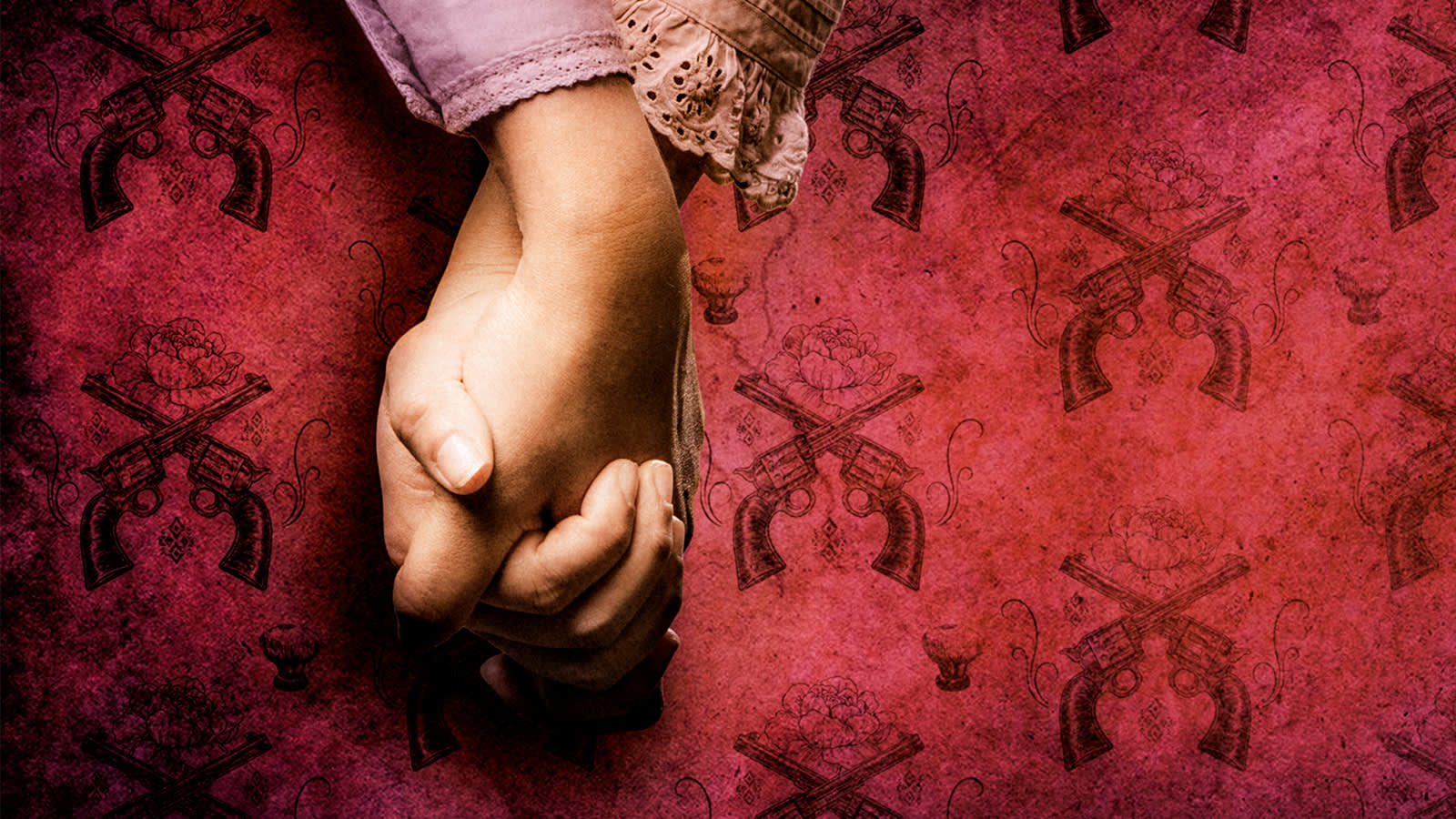
It’s one thing trying to solve a puzzle when the pieces don’t fit; it’s another when they’ve gone missing entirely. In the case of Angelica Chéri’s ‘15 (Grad Musical Theatre Writing) new musical Gun & Powder, an incomplete family portrait simply called for some creative license.
“So much of what I’ve known to be true… is also what I don’t know is true,” Chéri says. “The story keeps changing. That gave me the ability to piece together the truth with what I felt like was the most interesting throughline.”
Gun & Powder visualizes the mythical lives of Chérie’s great-great-aunts Mary and Martha Clarke, African-American twins who passed as white and leveraged that ambiguity to help their mother settle a sharecropper debt. Played by Solea Pfeiffer and Emmy Raver-Lampman, whose roles as siblings date back to their time together on Hamilton, the Clarke sisters are a gun-toting duo wreaking havoc on post-Emancipation Texas, and they won’t stop till they take back what’s theirs—or at least until romance gets in the way.
Chéri, who wrote the book and lyrics for Gun & Powder, pegged award-winning director Robert O’Hara to bring her family folklore to the stage. It’s a collaboration that challenges the frequently whitewashed Old West by pondering race, identity, and ownership, and thrusting two Black women to the forefront of a genre that has typically relegated similar characters. Chéri and her collaborator Ross Baum ‘15, who developed the music for the play, are alumni of the Graduate Musical Theatre Writing Program, an intimate two-year course that unites composers, lyricists, and bookwriters for participation in ongoing workshops. Gun & Powder was eventually workshopped as part of the graduate program’s inaugural collaboration with the New Studio on Broadway, and nearly six years later is set to make its world premiere at the Signature Theatre in Washington, D.C, on Tuesday, January 28.
The below conversation with Chéri has been condensed and edited for clarity.
How much did you strive for fidelity to the oral history of the Clarke sisters, and how much was this something you chose to make your own?
AC: The thing that was interesting about that choice is that so much of what I’ve known to be “true”... is also what I don’t know is true—because the story keeps changing. That gave me the ability to piece together the truth with what I felt like was the most interesting throughline. I wanted to make sure that the essence of it—that [the sisters] had a reason to leave and they wanted to do something to help their family—is what I ended up remaining most faithful to. Also, the fact that people couldn’t pin them down… I really wanted it to feel like there was this legendary, larger-than-life Thelma & Louise [feeling]. That untouchable outlaw narrative is what I wanted to keep intact.
At the heart of this musical is a century-old—but entirely relevant—dialogue about race and identity. It’s a springboard for a conversation about whether to assert or suppress one’s identity. What drove you toward these themes?
AC: “Passing” is something that is known within African-American culture but is not spoken about in mainstream culture. It is something that happens often. We see lots of images of women who are of color who are somewhat racially ambiguous in lots of popular culture—images in magazines and television shows. They’re of color, but it’s not entirely clear what their racial background is. And we have that juxtaposed against images of women of darker shades, and it’s just to kind of compare: What is blackness? What does it mean to be racially ambiguous? Who can claim blackness?
Even just talking to our performer Solea Pfeiffer, who plays ‘Mary,’ she said, “This is the first time I’ve been able to play me.” She is of mixed race, and she said she’s constantly passing in different roles. She’s playing characters of various ethnicities, but never just herself: someone who is black and white and dealing with that because we have a culture of definitive lines and boxes.
Also, this idea of how much color-culture affects access in American culture. I was at the National African American Museum in D.C., and I ran across something that I had known about for many years but never saw displayed in public in a way that marketed a piece of cultural history. And that’s the brown paper bag test. This test, where certain organizations and different people would be tested, they would hold up their skin to a brown paper bag. If they were lighter or darker than the brown paper bag, then they could have or couldn’t have access to certain organizations, or be married to certain people, [or join] certain sororities and fraternities.
Even though we may not know about [these activities] or practice them anymore, they’re still pervasive in our culture as Americans, and especially in African-American culture.