A New Tisch Institute Connects Critical Inquiry and Artistic Practice

Tuesday, Oct 27, 2026

Earlier this fall, the Tisch School of the Arts formally announced the creation of the Institute of Critical Studies in the Arts (ICSA) to bring together the Department of Art & Public Policy, the Martin Scorsese Department of Cinema Studies, and the Department Performance Studies. The new Institute unites three programs whose areas of study advance theory, historical research, and critical and social analysis in direct conversation with art-making. Additionally, ICSA also houses TDR | The Drama Review, a forum for radical performance and theoretical intervention for over 70 years.

Under the leadership of Associate Dean André Lepecki, ICSA departments will host world-renowned faculty to lead a graduate and undergraduate student body researching at the forefront of critical studies—specifically with an emphasis on live performance, cinema and video, and activism and policy. Associate Dean Lepecki, who previously served as chair of the Department of Performance Studies, recently spoke about the essential role of critical inquiry in the arts, its evolution in an age of new media and social performance, and how ICSA can shape the future of research at Tisch and beyond. 

There is a unifying thread between the three departments that make up ICSA: Art and Public Policy, Cinema Studies, and Performance Studies. How would you define the relationship between these areas of study?

André Lepecki: The three ICSA departments are dedicated to the production of critical theory, as well as historical and social analyses, of all sorts of artistic practices involving live performance, film, the relation between art and activism, and more. But the fact that they are situated at Tisch means that their theoretical production happens in proximity to artistic practice—and that's quite unique to our school. Because of their focus on the production of theory and social and cultural analysis, any of the three ICSA departments could easily be housed, say, at the College of Arts & Sciences. But the fact is that they were all founded at Tisch. They have historically been part of our school. Their faculty and their students have chosen to be at Tisch. And the Tisch deans have also historically chosen to support and house these scholarly departments, with their BA, MA, and PhD programs. The founding of ICSA reflects Dean Rubén Polendo’s acknowledgement of that past and is a bet on the role of critical studies in Tisch’s future. 

By being in proximity with the arts, the ICSA departments generate a very specific kind of critical discourse. One informed by the concerns, terminology, and artistic output emerging from the larger Tisch artistic community, from our students and faculty. As ICSA scholars, we develop our analytical frameworks thanks to this unique situation. We are scholars that can really feel the pulse of how art and society interact today. Therefore, I would say that our scholarly output, the books, conference papers, peer-reviewed articles, MA theses, and doctoral dissertations, by ICSA faculty, students, and alums are particularly attuned to what drives artistic creation today, precisely because it is all around us. 

The interesting thing is how the scholarship produced in the three ICSA departments is literally re-defining and intervening directly on how the arts are presenting themselves to the larger public today. To give a couple of examples, a PhD alum in Performance Studies, Adrienne Edwards, has been for a few years now the Director of Curatorial Affairs at The Whitney Museum. Or, think about Walter Forsberg, a MIAP alum (the master’s program in image preservation in Cinema Studies) who was Curator of Audiovisual Media at Smithsonian Libraries and Archives between 2022-26. These are just two examples among many of how our alums—or even our current doctoral students at the ICSA departments—are informing and transforming the practices of significant cultural institutions. My own take is that these institutions would only hire someone with a degree in performance studies or cinema studies or in art policy—as opposed to degrees in curatorial studies, art history, or visual culture—precisely because we are developing a kind of critical discourse that is unique, one that reflects and expresses the current concerns of artists.
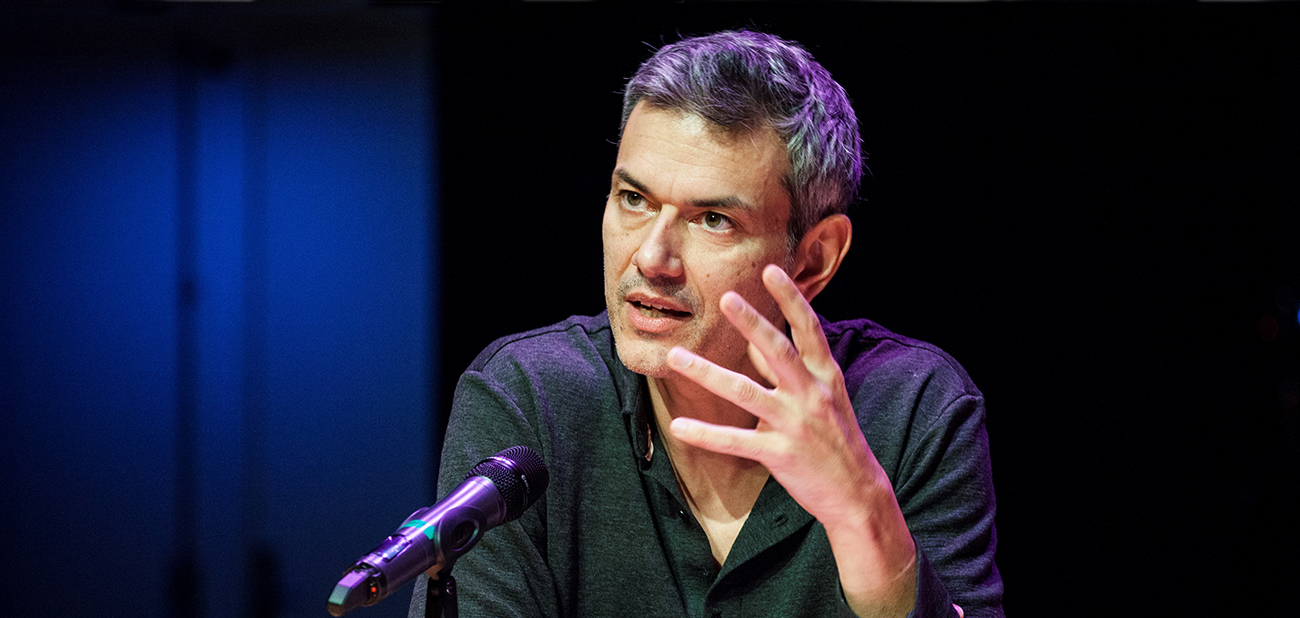
Man speaks and gestures with hand
Associate Dean André Lepecki

Do you find that the cohesion under the new Institute could make the work more legible and accessible to both students and the public?

Lepecki: When I run into NYU students or alums out there in the world (and there are so many of us out there!) they’ll often ask, “So, what do you teach?” And when I tell them that I teach critical theory in relation to dance, or that I teach courses on the history of political philosophy in its relation to aesthetic theories of movement, their reaction inevitably is: “Tisch has those kinds of critical studies departments?!” So, if the newly created Institute of Critical Studies in the Arts, can somehow make it clear to the world that Tisch indeed has always housed these departments, always had a belief that making art and reflecting on art must always go side-by-side, then I do think that ICSA will help draw more like-minded people, people who want to think about art theoretically, critically, sociologically, and historically, to our School. My hope is that ICSA will help bring to our vibrant Tisch community the next great film or performance scholar, the next great thinker on the relation between art and politics, the next great philosopher of art, who would perhaps never consider Tisch as a home for their studies because they might be looking at departments of anthropology, or art history, or sociology, or cultural studies, or philosophy, usually not situated in a School of the Arts.

Again, critical studies have been part of the DNA of the Tisch School of the Arts since its inception. It was brought here by people such as Professor Richard Schechner, who's now Emeritus Professor, when he first came to Tisch in 1966, and later became one of the co-founders of the Department of Performance Studies; or by Professor Robert Gessner, who founded the department of Cinema Studies in 1968. Or by the sociologist Randy Martin, founder of the department of Art and Public Policy. These three departments were the first degree- granting programs in the world in their respective fields. So, Tisch has literally been a school inventing critical thinking for decades. Professor Schechner also brought with him a very important journal to Tisch, TDR, which remains the international journal of reference in theatre, dance, and performance studies, and is now also housed at ICSA. Today, between the Martin Scorsese Department of Cinema Studies and the Department of Performance Studies, there are more than 400 PhDs in critical studies in the arts that have come out of Tisch working in all continents. These dissertations have helped re-shape current discourses in the cinematic and the performing arts, nationally and internationally. Not to mention, as I already pointed out, the incredible accomplishments of our alums, everywhere in the world, working not only in academia, but in museums, dance and theater companies, art centers, cultural centers, film festivals, etc.

As you mention, there is a rich history of critical studies at Tisch. How have we seen the work of Tisch students and alumni impact the field?

Lepecki: Let me give you a very recent example. I’m currently part of a PhD committee for a defense that's happening next month at the École de Hautes Études en Sciences Sociales, in Paris. One of the chapters of this dissertation is about a choreographer who's leading hip-hop workshops with groups of kids in the periphery of Paris. Now, the book that the choreographer is basing a part of their pedagogical practice on is by a Tisch alum in Performance Studies, Danielle Goldman, who's currently Director of the Dance program and an Associate Dean at the New School. I give this example to emphasize that scholarship coming from ICSA departments is not only analyzing art; it is also providing discursive tools that inspire compositional procedures, which then start to inform artistic work. There's a very interactive feedback loop between theory production and artistic practice, and this is just one example out of so many doctoral dissertations and other books coming from the three ICSA departments’ faculty, students, and alums. In sum: ICSA is indeed a new institute. But this new institute is basically the school recognizing the fact that critical discourse in the arts has always been a defining trait of Tisch. The fact that Dean Polendo formalized this history into a new Institute is nevertheless of tremendous importance. It is a strong affirmation of a vision not only for our school but for how the arts and the humanities, creativity and reflection, are inextricable partners in co-creating a social future that believes in the power of thinking-with and thinking-across. 

How has the approach to this scholarly work changed in the era of social media and limitless digital content?

Lepecki: The change in approach has been to look at new media as a new space for even more social performance. All sorts of new performances, new images, new language, new modes of mobilization are emerging all the time. So, first, social media is for sure a new “object” for thinking critically about society at large. But social media has become so pervasive as to function today as a literal extension of our bodies and our minds. We need to think about these new modes of living and interfacing with the virtual. And, also, we need to imagine how social media, or any future new media, can also be a site for the production and dissemination of critical theory. 

Being simultaneously a new phenomenon for study and a new medium for critical discourse, social media, new media, AI, all demand the invention of new methodologies for critical theory. We now need to ask: what does it mean to be doing dance studies when the place that you would usually go to see dance would be a theater, or a jam session studio, but now it is your phone? How is it that we respond critically, or correspond discursively, to these changes in the way society represents itself? How does that create challenges to our approaches? What does it mean for humans to think about their behaviors in the age of AI?

One thing is for sure: in a moment when critical thinking, theory, social analysis, the humanities, and the arts are under enormous pressure, if not direct attack, the creation of an Institute of Critical Studies in the Arts speaks volumes about Tisch’s and NYU’s vision regarding their research mission and their social responsibility in promoting a renewed alliance between the arts, the humanities, and the social sciences; between creativity and critical inquiry.