Earlier this fall, the Tisch School of the Arts formally announced the creation of the Institute of Critical Studies in the Arts (ICSA) to bring together the Department of Art & Public Policy, the Martin Scorsese Department of Cinema Studies, and the Department Performance Studies. The new Institute unites three programs whose areas of study advance theory, historical research, and critical and social analysis in direct conversation with art-making. Additionally, ICSA also houses TDR | The Drama Review, a forum for radical performance and theoretical intervention for over 70 years.
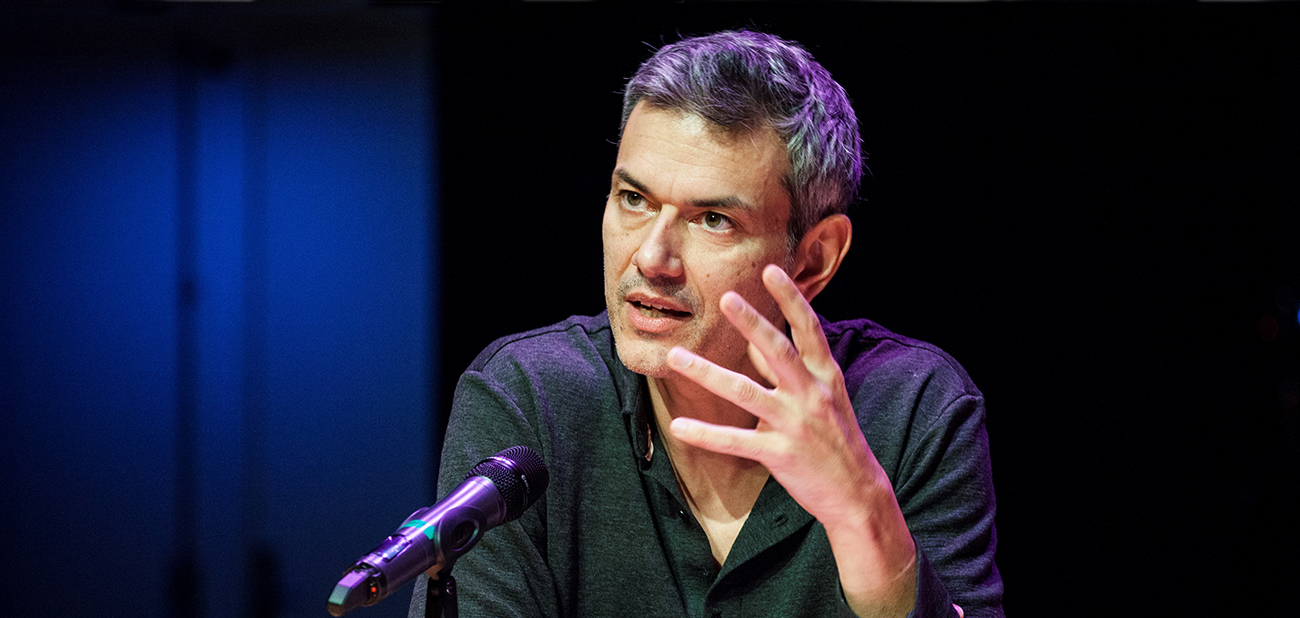
Under the leadership of Associate Dean André Lepecki, ICSA departments will host world-renowned faculty to lead a graduate and undergraduate student body researching at the forefront of critical studies—specifically with an emphasis on live performance, cinema and video, and activism and policy. Associate Dean Lepecki, who previously served as chair of the Department of Performance Studies, recently spoke about the essential role of critical inquiry in the arts, its evolution in an age of new media and social performance, and how ICSA can shape the future of research at Tisch and beyond.
There is a unifying thread between the three departments that make up ICSA: Art and Public Policy, Cinema Studies, and Performance Studies. How would you define the relationship between these areas of study?
André Lepecki: The three ICSA departments are dedicated to the production of critical theory, as well as historical and social analyses, of all sorts of artistic practices involving live performance, film, the relation between art and activism, and more. But the fact that they are situated at Tisch means that their theoretical production happens in proximity to artistic practice—and that's quite unique to our school. Because of their focus on the production of theory and social and cultural analysis, any of the three ICSA departments could easily be housed, say, at the College of Arts & Sciences. But the fact is that they were all founded at Tisch. They have historically been part of our school. Their faculty and their students have chosen to be at Tisch. And the Tisch deans have also historically chosen to support and house these scholarly departments, with their BA, MA, and PhD programs. The founding of ICSA reflects Dean Rubén Polendo’s acknowledgement of that past and is a bet on the role of critical studies in Tisch’s future.
By being in proximity with the arts, the ICSA departments generate a very specific kind of critical discourse. One informed by the concerns, terminology, and artistic output emerging from the larger Tisch artistic community, from our students and faculty. As ICSA scholars, we develop our analytical frameworks thanks to this unique situation. We are scholars that can really feel the pulse of how art and society interact today. Therefore, I would say that our scholarly output, the books, conference papers, peer-reviewed articles, MA theses, and doctoral dissertations, by ICSA faculty, students, and alums are particularly attuned to what drives artistic creation today, precisely because it is all around us.
The interesting thing is how the scholarship produced in the three ICSA departments is literally re-defining and intervening directly on how the arts are presenting themselves to the larger public today. To give a couple of examples, a PhD alum in Performance Studies, Adrienne Edwards, has been for a few years now the Director of Curatorial Affairs at The Whitney Museum. Or, think about Walter Forsberg, a MIAP alum (the master’s program in image preservation in Cinema Studies) who was Curator of Audiovisual Media at Smithsonian Libraries and Archives between 2022-26. These are just two examples among many of how our alums—or even our current doctoral students at the ICSA departments—are informing and transforming the practices of significant cultural institutions. My own take is that these institutions would only hire someone with a degree in performance studies or cinema studies or in art policy—as opposed to degrees in curatorial studies, art history, or visual culture—precisely because we are developing a kind of critical discourse that is unique, one that reflects and expresses the current concerns of artists.