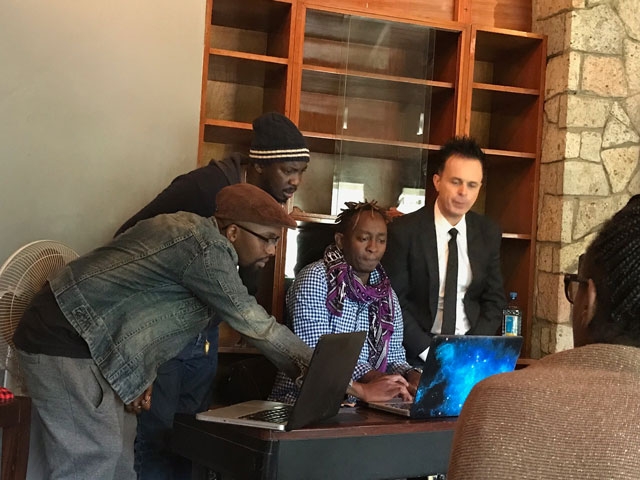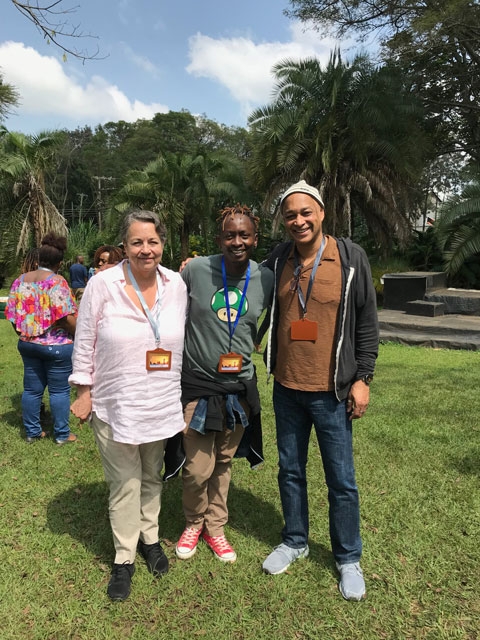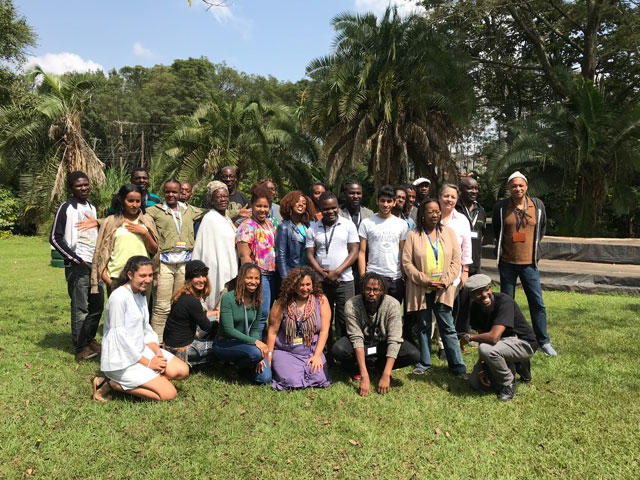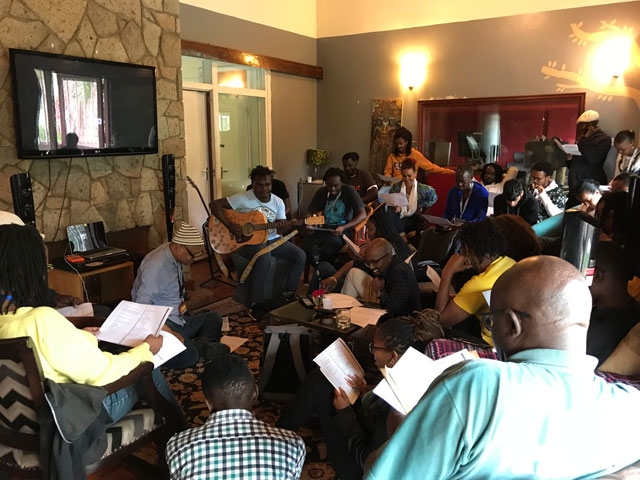
Two of our faculty members, Deborah Brevoort and Fred Carl, traveled to Nairobi, Kenya this past summer to lead a new musical theatre workshop initiative for creative artists. The workshop grew out of a relationship that the Program began with Eric Wainaina, a famous musician in Kenya, who visited the Program last year. We spoke to Deborah and Fred about their experience:
Can you describe the initiative as well as its purpose and goals?
Deborah: There’s a composer in Kenya named Eric Wainaina who is basically one of Kenya’s leading pop star musicians / singer-song writers, and he had participated in the Sundance Institute Theatre Lab with a musical that he will be bringing to the New Victory Children’s Theatre in New York City this fall. Eric was excited about the prospect of creating new musicals that were based in Kenyan stories and written by Kenyan composers and authors because there’s basically no resources over there to develop that sort of thing. So, he asked Roberta Levitow, the Senior Program Associate-International with the Sundance Institute Theatre Program, how they could put something like this together. Roberta began trying to mentor them herself (as Sundance is not a teaching organization), but eventually came to me because she didn’t have the skills to give Eric and his cohort what they needed. She asked me if I would consider going to Kenya to participate in a workshop that Eric was going to put together. I told her that I’d be happy to, but that I would not want to do this without a composer because if they were going to create musicals they’d need both a wordsperson AND a composer. She asked me if I had any ideas for composers and I told her that I knew someone at NYU named Fred Carl who would be perfect. That led to a conversation about whether or not we could collaboratively create something with NYU. So, we literally got up from the café where we were at and came over to The Graduate Musical Theatre Writing Program and spoke to the Department Chair, Sarah Schlesinger, who loved the idea, but told us that NYU couldn’t be an official sponsor. She did, however, tell us that the Program certainly had resources that it could share. I then went and asked Fred if he would be interested in participating in the workshop (which was being invented as I was speaking to him about it), and he said he definitely was interested. I then began uploading libretti of different musicals for the Kenyan participants to read and, long story short, Eric went around and rounded up the best creative artists he could find in Kenya: musicians, composers, authors, playwrights, performance artists, children’s authors, etc. It was very spontaneous. He would approach different creative people and tell them, “Hey, we’re going to do this creative workshop. If you’re interested, show up at The Elephant,” (which is the leading venue for new music in Nairobi, Kenya. It’s basically a house and a compound with recording studios).
Fred: Yeah. As Deborah mentioned, Eric assembled a group of artists into teams with anywhere from 2-8 artists in each team. We very quickly realized that Eric, because of who he is, was able to attract groups of artists (whose work he had seen or experienced) to come and participate in the workshop.
Deborah: Eric’s philosophy was: ‘I’m throwing open the doors’, and Fred and I went over and didn’t know who was going to walk in. In fact, as the workshop progressed, people started hearing about it around Kenya and just started showing up. And so, when we started out, we began with 10 “teams” who would say, “Okay we wanna come in and write a musical about such and such a topic,” and Fred and I would talk to them about it for a half an hour. And then another team would come in and we’d say, “Okay, well why don’t you start exploring that idea and come back in tomorrow?” And then the next day they would come back, but the team would be different. Instead of 2 people, there’d be 3 people, or 6 people. They were collaborating and writing together. The whole thing was fluid and moving. Our 10 musicals turned into 16 musicals, and there were even more who wanted to participate but we just didn’t have enough hours in the day.
Fred: We had observers who ran theatres as well as a couple of theatre groups who showed up. Nairobi is a large cosmopolitan city, and my sense was that the arts scene—I’m talking about fashion, dance, the intellectual writers: poets, fiction writers, non-fiction writers, playwrights, journalists, publishers, musicians, singers, composers—is pretty tightly knit. So, a lot of people ended up knowing one another.
Would they assemble themselves into pairs or groups?
Fred: Sometimes they would and sometimes Eric and Angela Wachuka, one of his associates, would assemble the groups. They knew them better than we did. Some people had already worked together and others had not and were meeting for the first time.
Deborah: We also had individual artists who were invited as “speed daters” and would come in and sit in on the sessions with us, and by the end, they would then organize their own collaborative clumps – though not always in the way we would have done it. It was really thrilling.
Fred: And everyone was just thrilled to be there. Getting the work out of people was not an issue at all.
Deborah: Hungry. That’s the operative word for this. Everyone was hungry.
Fred: They were familiar with film musicals such as Fiddler on the Roof and West Side Story, but a lot of them hadn’t seen stage versions of musicals, so we were able to introduce a few shows to them that they didn’t know.
Deborah: The format was that Fred and I would be there every morning from 9 AM to 1 PM and we would just meet with individual teams—whatever that group happened to be—and they would talk to us about what they wanted to do. It was sort of like an NYU lab, but less intrusive than what we would do at the GMTWP. We were just sprinkling a little water because we weren’t trying to form anything. We were just there to nourish and nurture. Then in the afternoon we would take turns teaching. I would do lyric writing and song form and Fred would help them find the song moment in the scene and push their understanding of the power that music has in this form. We would then hold a listening session. We really limited what we did and didn’t throw too much at them. We really focused on opening numbers, duets, and basic verse-chorus and AABA song forms.
Fred: We’d sneak in things about ensembles and their function and a couple of conversations about narrative storytelling and non-linear storytelling. We got a lot done.
Were they primarily short-form pieces or were they discussing whole pieces?
Fred: Everyone was working on a full-length piece of some sort. There was one one-act, which was a full-length piece for children. Everyone was working on ideas that could be developed into a whole piece.
And then you would help them apply technique and craft to whatever they were doing?
Fred: Yeah, we would take it from wherever they came.
Deborah: Whatever walked in the room, we talked to that.
Fred: They dealt with opening numbers in most cases. We would raise the questions, ‘What does this opening for this show need to let an audience know? What world does this need to crack open?’ The answers were different for each piece, and people were in the room listening to those differences. No one thought, “Oh, what I’m doing is what you should be doing.” They would watch someone else’s process, but also keep it very much focused on their own individual concerns. They would get the lessons from us but also from each other. And then they were able to incorporate lessons into what they were doing specifically, which was always very different from what everyone else was doing.
Deborah: A lot of artists wanted to come in and just listen to us talk to other artists about their projects. There was only one artist who wanted private labs. We had one artist come in from Ethiopia (which is interested in doing a similar kind of workshop) who was basically with us morning, noon, and night to just observe. We threw open the doors and anyone could come in.
Fred: The goal was for everyone to have at least 10 to 15 minutes of something to present at the end of the 2-week process. Almost everybody did that, and they all performed it. They would perform their own stuff as well as each other’s work. Or, they put things on tape. It was up to them to decide how to present their materials.
And you were there for 2 weeks?
Fred: Yes. 2 weeks.
It’s so interesting to hear about the different creative facets and abilities that everyone contributed in order to create something—which brings me to my next question:
What was the process of incorporating the unique culture and perspectives of the creative artists into their musicals?
Fred: There are many multiple languages that are spoken in Kenya by the over 40 different ethnic groups. There are some dominant languages, but everyone who participated in the workshop spoke at least 3, if not 5 languages, and those languages all come with their own cultural significances.
Deborah: They were writing musicals in Swahili, Dholuo, Kikuyu, and others. Some musicals had 3 languages in it.
Fred: We were very clear with them to not make concessions for us. We’d ask them who their audience would be, and if they brought in material written in English we would ask them to explain why. If it was a Nairobi audience, they’d understand all of those languages. People would bring in something for us to hear which was written in Kiswahili, or Kikuyu, and then we would explain what we thought was happening in the piece or what we thought one character was saying to another character, and the writers would respond with, “Yeah, that’s exactly what just happened.”
Deborah: There were no translators but we had no problems understanding.
Fred: The emotional storytelling was happening at a high enough level so that we could understand. Obviously, we didn’t always catch the nuances of the languages, but I don’t necessarily catch those even when I see shows in English. But understanding the emotional core of the story was not a problem.
Deborah: We did not impose certain ways of songwriting onto pieces that didn’t necessarily subscribe to that. I did a whole section on AABA song form to explain how it gives you a dramatic structure, but there was a writer named Elsaphan Njora who was doing really non-linear performance art—incorporating spoken-word monologues with movement, etc. I told him to think of AABA, but not DO AABA. I then asked him where the B section was in his piece, which helped him realize that he needed a new thought to help him get to the ending. He needed the pivot. So, he was able to take song form and use it in a way that fit what he was doing. We had a lot of pop composers who work primarily in verse/chorus, and though they didn’t need to be taught about that song form, they did discover how to use it to create progressions.
Fred: And what I found was that the conversation was frequently about transitions. For instance, if they were using verse/chorus form where a beat would follow the song, I could ask them to figure out a transition that would then give a forward motion from one thing to the next and which would allow them to refer to what they just did. There was a lot of conversation about transitions. They started to see how to put things together and how things can tie into one another. I didn’t think of them as students. They were professionals in their field who were coming in and using what they already knew to apply it to help tell a story.